Sunday, January 5, 2014

RBI cautions against use of bitcoins

TNN | Dec 25, 2013, 01.31AM IST

MUMBAI: The Reserve Bank of India (RBI) has issued a caution notice against bitcoins and other virtual currencies saying that users may end up violating laws against money laundering and terror financing.

Stopping short of declaring a ban on their purchase, RBI said it is examining the issues associated with the usage, holding and trading of virtual currencies under the extant legal and regulatory framework of the country, including Foreign Exchange and Payment Systems laws and regulations. "The creation, trading or usage of virtual currencies (VCs), including bitcoins, as a medium for payment are not authorised by any central bank or monetary authority. No regulatory approvals, registration or authorisation is stated to have been obtained by the entities concerned for carrying on such activities. As such, they may pose several risks to their users," RBI said.

Governments in Europe have expressed similar concerns about bitcoins.

In its cautionary advice, RBI said that it is looking at the developments related to certain electronic records claimed to be "decentralised digital currency" or "virtual currency", such as, bitcoins, litecoins, bbqcoins and dogecoins, their usage or trading in the country and various media reports in this regard.

Driven by speculators, the value of a bitcoin had shot to $1,124 in November from $13 in January 2013. But its price crashed by 50% after China banned financial institutions from bitcoin transactions earlier this month. In India, the price of bitcoins has fallen to Rs 42,737 from Rs 74,628 in November.

Among the risks, RBI has listed loss due to hacking and malware, loss of password and the absence of an established framework for recourse to customer problems and disputes. But the central bank's main concern appears to be that virtual currencies are being used for illegal activities. "There have been several media reports of the usage of VCs, including bitcoins, for illicit and illegal activities in several jurisdictions. The absence of information of counterparties in such peer-to-peer anonymous/pseudonymous systems could subject the users to unintentional breaches of anti-money laundering and combating the financing of terrorism (AML/CFT) laws," RBI said.

The central bank had earlier described virtual currency as a type of unregulated, digital money, which is issued and usually controlled by its developers, and used and accepted among the members of a specific virtual community. Virtual currency schemes provide a financial incentive for virtual community users to continue to participate and are able to generate 'float' revenue for their owners.

Bitcoins are the fastest growing currency in the internet world. They are stored by users in the form of a private key which enables transactions. The private key can be stored in an electronic wallet, which can be a client in a computer or in a pen drive. Unlike fiat money issued by governments or bullion, bitcoins are electronic records of the ownership of the virtual currency. The virtual currency offers users the advantage of low transaction costs and interoperability. But regulators are worried as this route can be used to circumvent laws and government sanctions. Earlier this year, US authorities cracked down on a virtual currency service company - Liberty Reserve - alleging that it was involved in money laundering.

There is no underlying or backing of any asset for virtual currencies. As such, their value seems to be a matter of speculation. Huge volatility in the value of VCs has been noticed in the recent past. Thus, the users are exposed to potential losses on account of such volatility in value.

"It is reported that VCs, such as bitcoins, are being traded on exchange platforms set up in various jurisdictions whose legal status is also unclear. Hence, the traders of VCs on such platforms are exposed to legal as well as financial risks," RBI said.

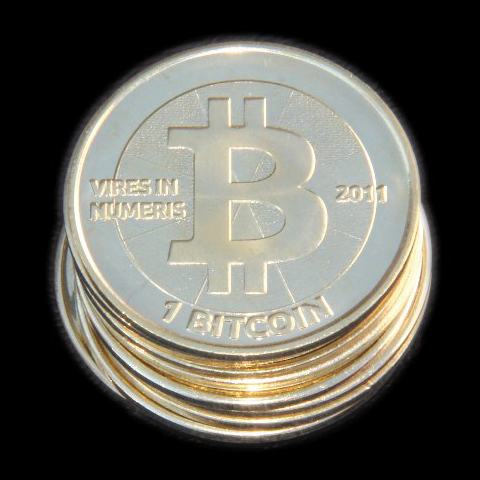
Physical Bitcoins by Casascius

https://www.casascius.com/


Nov 27, 2013: For the time being, I have suspended accepting new orders, pending resolution of some concerns I have as to regulatory issues. I am anticipating a possibility of having to prequalify buyers, and am holding off taking orders until I know for sure.

Casascius Bitcoins are physical coins you can hold - and each one is worth real digital bitcoins. 

Bitcoin is the most widely used open-source peer-to-peer "cryptocurrency" that you can send over the Internet without a bank or a middleman.

Each Casascius Bitcoin is a collectible coin backed by real Bitcoins embedded inside.  Each piece has its own Bitcoin address and a redeemable "private key" on the inside, underneath the hologram.

Current products available for sale:

฿1 Casascius Coin: This is a solid brass coin.  Each 1-bitcoin coin is about 1.125inch (28.6mm) in diameter (just bigger than a US quarter but smaller than a half-dollar) and weighs a quarter ounce.  Perfect as a small gift to introduce someone to Bitcoin.  Also available in a ฿0.5 version which is slightly smaller at 1 inch (25.4mm).

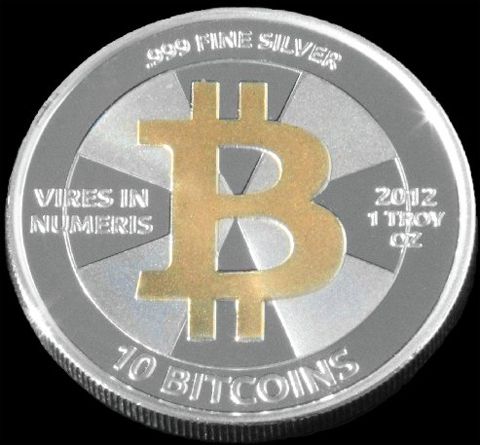
฿1 Gold-Plated Fine Silver Casascius Round. This is a 39mm 1oz silver round accented with gold electroplating on the rim and on the Bitcoin logo, loaded with one digital bitcoin.

฿0.5 and ฿0.1 Fine Silver Casascius Rounds These are a half-ounce and quarter-ounce rounds (respectively) of fine silver. Diameters are 30mm and 25mm.

Casascius 2-Factor Gold-Plated Savings Bar: Dress your Bitcoins for tomorrow, make them look their best in your vault today.  Would weigh about 12 ounces if it were solid gold, this is a 4.2-ounce metal alloy bar with gold plating.  A neat-looking novelty that looks unmistakably valuable.  Available as a pre-loaded 100 BTC bar, as well as a non-denominated savings bar.  Two-factor encryption is available at no charge.  Bar is 80mm x 40mm x 6mm.

How they work: The "private key" is on a card embedded inside the coin and is protected by a tamper-evident hologram.  The hologram leaves behind a honeycomb pattern if it is peeled. If the hologram is intact, the bitcoin is good. If you have purchased a 2-factor item, the private key is encrypted and will need to be decrypted using your original preselected passphrase before you can redeem the funds.

The 8-character code you see on the outside of the coin is the first eight characters of the Bitcoin address assigned specifically to that coin.  You can verify the coin's balance on Block Explorer.  There is a mathematical relationship between the Bitcoin address and the private key inside the coin. The digital bitcoin is actually located on the public "block chain" stored on the internet, but it is completely inaccessible to anyone unless the private key from the coin is loaded into a Bitcoin wallet.

To recover the digital bitcoins, there are several ways to convert the embedded code back into a digital bitcoin so it can be spent over the internet.  Most importantly, none of the methods relies on me or any other central issuer, due to Bitcoin's completely decentralized design.  The embedded private key code is everything a Bitcoin client needs to find and claim the digital Bitcoins from the peer-to-peer network. For example, you can enter (or "import") your coin's private key code directly into Bitcoin clients such as Armory, Blockchain.info, or directly into Mt. Gox as a deposit method.  (Casascius coins use the "minikey" private key format, and the main Bitcoin.org client does not yet support redeeming minikeys.)

Of course, since the face value of the coins depends on the integrity of the embedded key code, you should only accept Casascius Bitcoins bearing an undamaged Casascius hologram from others.

E-mail is casascius at mc2cs.com.

Links:
  • Frequently Asked Questions
  • Casascius Wordpress Blog
  • Free High-resolution coin photos
  • For more high-quality Casascius-related photos suitable for press use, go to gettyimages.com and search for Mike Caldwell or Bitcoin.
  • More about Bitcoin: We Use Coins.
  • Casascius Coin trackers (made by fans) casascius.uberbills.com casascius.appspot.com
  • I only accept Bitcoins for payment for these items.  I do not accept any form of national currency such as Dollars or Euros for my products. However, you may be able to buy Casascius Coins from others on eBay for such currencies.
  • Please note that I am relatively slow to ship products!  Delays of 7-10 days may be common, I consider myself mainly a wholesaler.  Things that slow me down include: my other responsibilities, other Bitcoin-related activism and projects, the unusual and often inconvenient procedures I go through to keep my products and bitcoins secure, and the fact that I might need to create or engrave your items before I can ship them.  Please consider shopping from resellers, eBay, or BitMit for fastest service.
  • Casascius LLC Terms and Conditions

My PGP key

World’s First Bitcoin ATM Launched in Canada

 
Latest move toward mainstream use for virtual currency

By Per Liljas Oct. 30, 20132 Comments


186215833

David Ryder / Getty Images

Katrina Caudle celebrates after using the world's first bitcoin ATM at Waves Coffee House on October 29, 2013 in Vancouver, British Columbia, Canada.

Bitcoins took yet another step toward mainstream use on Tuesday, as the world’s first ATM converting the virtual currency to conventional cash, and vice versa, was introduced at a coffee shop in Vancouver, Canada.

The machine will be operated by the bitcoin exchange companies Bitcoiniacs and Robocoin, and will perform transactions after a palm and ID scan, CBC reports. Four more ATMs are planned for the country in the near future.

Bitcoin, which made headlines as a method to buy illegal products on “deep web” portals such as the recently-raided Silk Road, is also gaining prominence among high street stores in Western Canada. Bitcoiniacs reported that it was selling the currency, valued at $12 in January, for around $200 today.

http://business.time.com/2013/10/30/worlds-first-bitcoin-atm-launched-in-canada/

Bitcoins: missing the real revolution

January 4, 2014

Updated: January 4, 2014 01:38 IST

Vasudevan Mukunth

BTC: Some investors have been smart enough to spot the potential for innovations that are proliferating on diverse fronts. A representational picture.

AP BTC: Some investors have been smart enough to spot the potential for innovations that are proliferating on diverse fronts. A representational picture.

The strength of cryptocurrencies like bitcoins has little to do with its monetary potential and more to do with its technical potential

The year 2013 was unequivocally the year of bitcoins, more than it will be the year of the commercialisation of 3D printers or the advent of private space flight. The bitcoins mining and transactions network first came online in late 2008, saw an adoption boom in early 2012, and got the attention of investors and governments late last year. It’s not really been as much a roller-coaster ride as an initiation into the Gartner hype cycle, and the slope of enlightenment is nowhere in the vicinity.

Unfortunately for it, there’s a bigger problem: people have been having the wrong debate, all the way from those who want to get on the bandwagon because they know a bitcoin is worth $825.43 (1616 IST, January 3), to regulators arguing over whether or not cryptocurrencies can replace American dollars, to political economists asking if this is a libertarian agenda plotting to subvert the federal reserve. Needless to say, they’re all wrong.

There are two aspects to bitcoins: one as the digital currency that uses complex mathematical functions to be acquired, moved around and secured; the other as the transaction verification system. The former is the honey that attracts the bees, the occupant of mainstream imagination; the latter is the hive of the future, the real revolution.

The strength of cryptocurrencies like bitcoins has little to do with its monetary potential and more to do with its technical potential. What Satoshi Nakamoto, the enigmatic Japanese programmer(s) who conceived the bitcoins system, created is pertinent to the notion of a transaction cost: the price of mobilising your resources, irrespective of the nature of these resources.

Within the bitcoins transaction verification network, both value and validity are established democratically. The person who intends to use a bitcoin needs to show proof of work — that he mined or acquired the coin through legitimate means — and proof of knowledge — that the transaction being requested is verifiable. If most users on the network agree that a transaction was legitimate to the tune of some amount, then that’s that. The identities of the transactors are irrelevant.

In microfinance
Therefore, adopting bitcoins would help small businesses to grow unburdened by disproportionate transaction costs incurred to mobilise relatively small amounts. Even broadly, bitcoins hold the potential to reform microfinance in rural India. For example, some Assamese tea growers are exploring the option of transacting in bitcoins to avoid foreign exchange fees and the need to set up complex bank transfer wires between them — the producers — and their global consumers, often through middlemen such as PayPal whose participation comes with an automatic loss of value, around 7 to 10 per cent of the transaction.

Instead, using bitcoins means pure value transfer.

Scope for innovation
For transactions to hold their ground while preserving anonymity and ensuring security, the network of users needs to be large and consistent. And the rewards system that keeps these bees loyal is the bitcoin, the honey. Unfortunately, regulators and laymen alike have been paying undue attention to its value and the inherent anonymity. Some investors, on the other hand, have been smart enough to spot the potential for innovation.

Innovations are proliferating on diverse fronts, almost all of them building on the answer to the question why bitcoins are actually disruptive: they’re not erected on existing platforms but one all its own that’s strong on privacy and security. Bitmessage, for instance, is bitcoins all over again but with emails being sent around instead of coins. Gliph is Bitmessage for push-messaging. Coinbase, BTC-E and BitPay are PayPal with bitcoins. Even Visa and Mastercard are starting to see their counterparts in Canada, where the first bitcoin ATMs were installed for Christmas.

In fact, the most interesting application stemming from bitcoins I have heard was from American entrepreneur Chris Dixon, which factors in the cryptocurrency’s high divisibility. Like the rupee’s lowest relevant denomination at the moment is 25 paise, a bitcoin’s lowest relevant denomination is 1 satoshi, which is equal to 0.00000001 bitcoin. As of January 1 2033 hrs IST, one satoshi would have been worth 0.047 paise. This isn’t much.

Say, with every email you send, you are also required to send one satoshi to the recipient. Still not much. But what if you’re a spammer? What if you’re sending out tens of thousands of emails because you’re an annoying advertiser? You will also be sending out a few tens of rupees, and that’s a significant amount for an enterprise that used to be free. Suddenly, bitcoins’ high divisibility has become a tool to fight spam — that too without having to forge cumbersome relationships based on credit cards.

For all we know, bitcoins could be on their way out, but that wouldn’t be the real tragedy as much as that we let slip the best single solution we’ve had in years to tackle diverse issues that affect individual and small enterprises.

vasudevan.m@thehindu.co.in

Copyright© 2014, The Hindu